
MIT Creates Solar Cell From Grass Clippings
There are more and more new ways that people are finding to harness renewable solar energy from the sun. Now researchers at MIT have come up with a way to create solar cells from the molecules of plant life.
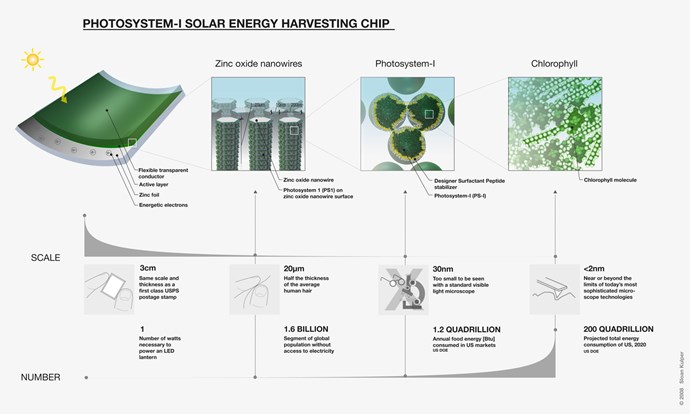
If you remember high school biology classes, you will hopefully remember a process called photosynthesis, whereby plants turn sunlight into energy. Mershin has found a process which extracts the photosynthesizing molecules, called photosystem I, from plant matter. Photosystem I contains chlorophyll, the protein that actually converts photons into a flow of electrons.
These molecules are then stabilized and spread on a glass substrate that’s covered in a forest of zinc oxide nanowires and titanium dioxide “sponges.” When sunlight hits the panels, both the titanium dioxide and the new material absorb light and turn it into electricity, and the nanowires carry the electricity away. In essence, Mershin has replaced the layer of silicon in conventional photovoltaic cells with a slurry of photosynthesizing molecules. “It’s like an electric nanoforest,” he says.
So far so good — now time for the reality check. At the moment, even with the efficiency-boosting nanoforest, Mershin’s solar panel only has an efficiency of 0.1%. To be of any use — to power more than a single LED light from an entire house covered in these cheap solar panels — an efficiency of 1 or 2% is required. With such a low barrier to entry, though, Mershin hopes that scientists the world over can now work on boosting the efficiency.
